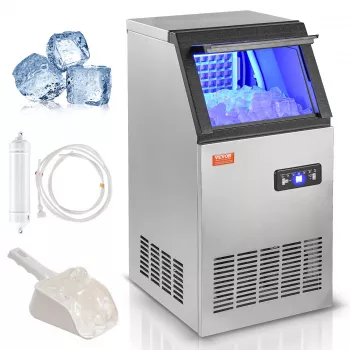
An ice maker’s daily ice production and built-in storage capacity affect everything from drink service speed to how often the bin needs to be emptied. This guide breaks down how an 80 lbs/24-hour machine with a 27.5 lbs storage bin typically fits into cafés, small bars, offices, and light commercial kitchens, plus practical sizing, placement, and maintenance considerations.
When shopping for a commercial ice maker, it helps to treat the two headline specs as answers to different questions. “Daily ice production” is about how much ice the unit can create over time, while “storage capacity” is about how much ice you can grab immediately during a rush.
| Spec | Value | Why it matters |
|---|---|---|
| Daily ice production | 80 lbs per 24 hours | Supports ongoing demand throughout the day when the machine can keep cycling |
| Storage capacity | 27.5 lbs | Determines how much ice is immediately available before the unit needs time to replenish |
| Production-to-storage relationship | Storage is ~34% of daily output | Helps estimate how quickly a rush can deplete the bin versus steady use |
An 80 lbs/day machine with a 27.5 lbs bin is often a practical “small commercial” choice: enough to keep up with steady demand, but not built for nonstop high-volume rushes without a plan.
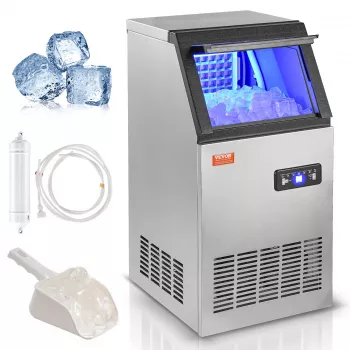
If you’re comparing models, the Commercial Ice Maker 80lbs/24 Ice Production & 27.5lbs Storage Capacity is a straightforward example of this capacity class: built to produce steadily and hold enough ice for normal surges without taking up the footprint of a larger bin system.
The easiest way to stress-test this size is to think in “busiest hour” terms. Storage is what you draw from during that hour; production is what helps you recover after it.
For general sanitation guidance, the CDC’s overview of cleaning and sanitizing is a useful reference point. For background on common water issues that can affect equipment, see the EPA’s consumer info on drinking water contaminants.
If you’re upgrading the customer experience around beverages (menu boards, seasonal promos, social posts) alongside your equipment, an internal resource like the AI-Driven Content Ideas Toolkit: 4-in-1 Bundle of eBooks, Guides, and Checklists for Social Media Success can help keep marketing consistent while operations run smoothly.
For additional efficiency context when comparing commercial equipment categories, ENERGY STAR’s hub for commercial food service equipment is a helpful starting point.
No. 80 lbs/day refers to total ice made over 24 hours under rated conditions, while the bin only holds about 27.5 lbs at a time; during peak demand, the bin can empty faster than the unit can replenish.
Many operators clean and sanitize every few weeks to monthly and descale on a similar schedule, but hard water may require more frequent descaling. Always follow the manufacturer’s directions and use ice-machine-safe, food-safe cleaners.
Common causes include hot ambient temperatures, warm inlet water, restricted ventilation, scale buildup, frequent lid openings, and heavy continuous draw that prevents full freeze cycles. Keeping the unit clean and well-ventilated usually restores performance closest to its rating.





Leave a comment
You must be logged in to post a comment.