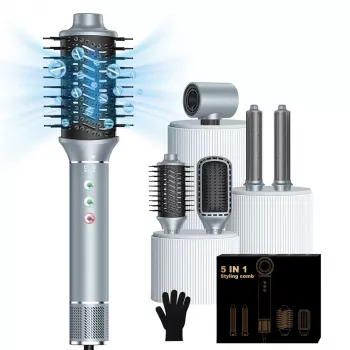
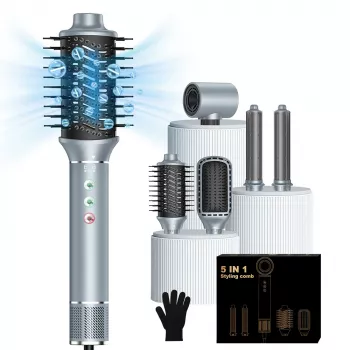
A high-speed hair dryer brush styler combines drying airflow with brush-based shaping so hair can dry while it’s being guided into place. Instead of bouncing between a blow-dryer, round brush, smoothing brush, and finishing tool, a 5-in-1 setup is built to streamline the routine with interchangeable attachments for different looks—smooth, volumized, softly bent, or quickly refreshed.
This type of tool is designed for practical, everyday styling: reduce the time spent rough-drying first and then re-styling afterward. By pairing airflow with brush tension, it helps keep hair controlled as it dries, which can make at-home blowouts feel less “all hands on deck” and more repeatable.
The set centers around a main high-speed dryer handle (the motorized base) that powers all heads. Swapping attachments mid-routine—roots first, then lengths and ends—helps tailor the finish without pulling out more tools.
| Attachment | Best for | Practical tip |
|---|---|---|
| Dryer / concentrator-style head | Fast rough-drying and directing airflow | Dry to about 70–80% before switching to a brush head for shaping. |
| Oval volumizing brush | Lift at the roots and a smooth blowout look | Work in sections; roll at the root and hold briefly to set lift. |
| Smoothing brush | Reducing frizz and guiding hair straighter | Use steady tension and slower passes instead of high heat. |
| Round brush / curling barrel-style head | Soft bends, flipped ends, and loose shaping | Wrap smaller sections for more definition; brush out for softer waves. |
| Finishing / flyaway-taming head | Polishing the top layer and ends | Keep airflow moving to avoid over-drying one spot. |
High-speed airflow is about drying efficiency. When evaporation happens faster, there’s typically less time needed with heat applied, which can be helpful for keeping hair feeling softer over time. Airflow plus brush tension also encourages strands to lie more uniformly, creating a smoother look even before finishing products.
For more guidance on reducing heat-related wear and tear, the American Academy of Dermatology Association outlines practical habits like using heat protectant and avoiding excessive heat exposure.
For additional appliance safety basics, review the U.S. Consumer Product Safety Commission guidance on hair dryer safety.
| Setup | Pros | Trade-offs |
|---|---|---|
| 5-in-1 dryer brush styler | One tool for drying + shaping; quick attachment swaps | Learning the right section size and tension takes a few uses |
| Traditional dryer + round brush | High control for experienced users; familiar technique | Requires coordination and more time switching tools |
| Flat iron after blow-dry | Very sleek finish possible | Adds a second high-heat step and extra time |
It’s better to towel-dry first, then rough-dry to damp before using brush attachments. Starting on soaking-wet hair can increase heat time and reduce control, especially near the roots.
Frizz control mostly comes down to technique: directing airflow downward, using steady tension, working in sections, and finishing with cooler air. The brush format can make it easier to keep strands aligned as they dry, which often helps the finish look smoother.
Focus on fully drying the roots, use smaller sections at the crown, and “set” the lift with a cool setting for a few seconds. Keep products lightweight and avoid heavy oils near the scalp.




Leave a comment
You must be logged in to post a comment.